
ASTRA bulletin: Reproductive Rights in a Changing Climate
The latest issue of the ASTRA Bulletin, published by the ASTRA Network, of which Freedom of Choice (Možnosť voľby) is a member, is out.
The Bulletin offers a regular overview of developments in sexual and reproductive health and rights (SRHR) across Central and Eastern Europe and Central Asia. It tracks key events, civil society achievements, and the challenges organizations in the region face.
This issue focuses on the link between the climate crisis and reproductive rights. ASTRA features two interviews: one with experts on climate finance and reproductive rights in Central Asia, and another with a researcher studying the connection between climate and reproductive health. They agree on one point: the climate crisis does not affect everyone equally, which is why reproductive justice must be part of the response.
You can find our contribution to the issue below.
✊ International Project 3R: Recognize, Resist, Rise Up: Tackling Gender-Based Violence Against Women in Politics
Before summer, we published the first study researching violence against women politicians in Slovakia. The release of the report was accompanied by a press conference with women lawmakers from both the opposition and the coalition, at which we jointly took a stand against violence.
The media interest led to an invitation for our statutory representative, Adriana Mesochoritisová, to appear on the popular and widely listened-to podcast “Ľudskosť,” (humanity) produced by one of Slovakia’s largest media outlets, the daily newspaper SME. We are very thankful that we had the opportunity to discuss research findings and to emphasize to the public that violence is a negative, yet common phenomenon in politics that we must all play a part in eliminating. We subsequently developed Recommendations for the Prevention and Resolution of Gender-Based Violence Against Women in Politics. The study focuses on recommendations for preventing violence in various spheres and differentiates recommendations for:
- society as a whole;
- representatives of law enforcement and the judiciary;
- online platforms and social media;
- the National Council of the Slovak Republic;
- political parties.
The Recommendations are only available in Slovak language. We have also drafted a Declaration of zero tolerance for violence against women politicians. We are currently calling on all elected officials, political parties, local governments, state institutions, law enforcement agencies, the media, academic institutions, civil society, and the general public to join this initiative and take active measures to eliminate gender-based violence against women politicians.
💔 On June 20, 2026, another woman lost her life in Slovakia
Another victim who was not killed by a stranger, but by someone who knew her and had been harming and intimidating her for a long time.
Zuzana was killed just a few days after a court granted her abusive husband a conditional suspension of his sentence, having determined that he posed no danger to those around him. And not only that: none of the responsible institutions ensured that the system acted to protect a woman who was afraid. There was no safety plan, and no electronic alarm devices were used.
This case of a clear failure on the part of Slovak institutions sparked a wave of outrage among some politicians, nonprofit organizations, and the public. A public petition signed by more than 11,000 people called on the government, the relevant ministries, and the Office of the Prosecutor General to immediately take measures to:
- the immediate implementation of a mandatory and standardized risk assessment in cases involving violence,
- establish binding multi-institutional coordination procedures among all components of the system for protecting women and children from violence,
- consistently enforce restraining orders, no-contact orders, and other protective measures, along with expanding the use of electronic monitoring.
To date, however, we have not heard that the government plans to implement a comprehensive and concrete strategy to better protect women who are victims of violence. The Istanbul Convention, which would provide better protection, was signed in 2011, but the Slovak Republic has not ratified it since then.
🎶 Pohoda festival 2026
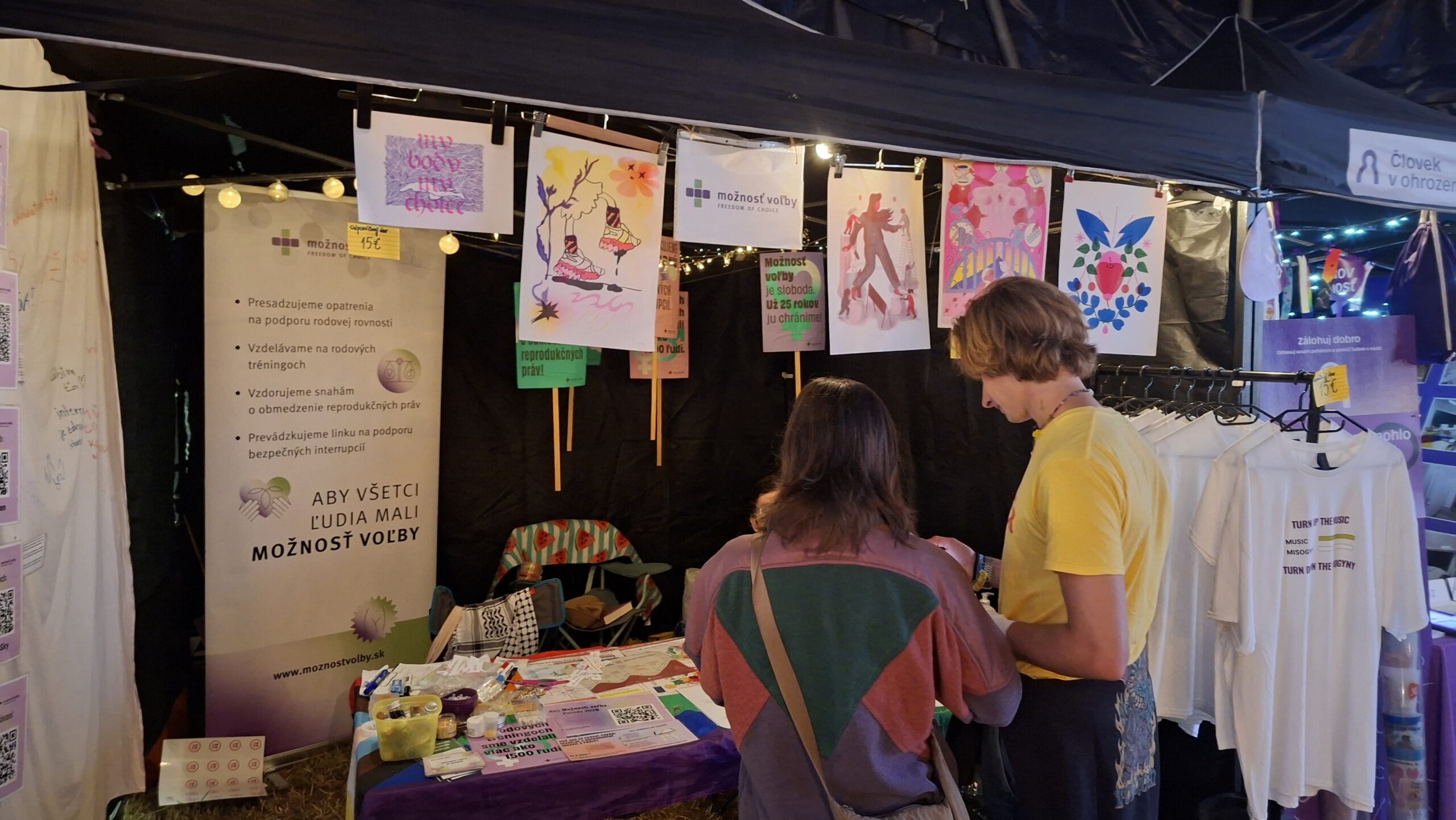
Freedom of Choice was once again part of Slovakia’s largest festival. As many as 33,000 people attended the 30th annual Pohoda Festival, offering us a unique opportunity to engage with a progressive audience open to supporting our cause. At our booth, we had prepared several interesting activities that drew people’s interest:
- A “Myth vs. Fact” card game addressing abortion in Slovakia;
- A “Match the Contraceptive to Its Name” game (originally created for our Health Day workshop at Comenius University). People were particularly intrigued by lesser-known methods like the diaphragm. This also gave us space to highlight our partner organization, InTyMyta;
- A friendship bracelet station where people could create bracelets, necklaces or charms with or without feminist slogans.
Alongside these activities, we highlighted the systemic barriers to abortion access in Slovakia, including the lack of reliable information, scarcity of healthcare facilities performing abortions, high financial costs, mandatory counseling and waiting periods, regional unavailability requiring long-distance travel and unavailability of medical abortion (abortion pill).
🫶We could not have accomplished this without the support of our incredible interns and volunteers: Dominik, Andy, Timea, Kika, and Laura.
💜 Support line
Most women reaching out through our helpline are currently in relationships, have 2 or 3 older children, and are facing an unplanned or unwanted pregnancy.
While most seek direct information, our growing network of NGOs and local initiatives has also allowed us to connect with women living in marginalized communities (particularly in the Prešov region). For them, additional pregnancies risk trapping their families in generational poverty—limiting employment options and restricting their capacity to care for their existing children.
Their stories heavily reflect the current housing affordability crisis:
“It’s not just about having another child—we have an €800 mortgage on our apartment. If I stop working, we’ll lose our home.”
Another woman we accompanied was actively fleeing an abusive partner while staying in a emergency shelter with her two children. Another shared:
“He wants to tie me down. I already have three children, and one is autistic. After my fourth pregnancy three months ago, I finally mustered the courage to run away to my parents. A week later, I found out I was pregnant again. I have to go through with [an abortion] 100%.”
We also saw a distinct group of young women, four teenagers aged 16 and 17 contacted us during this period. In addition to financial constraints, they were primarily seeking legal guidance on how to undergo an abortion without parental consent.
📚 Gender trainings
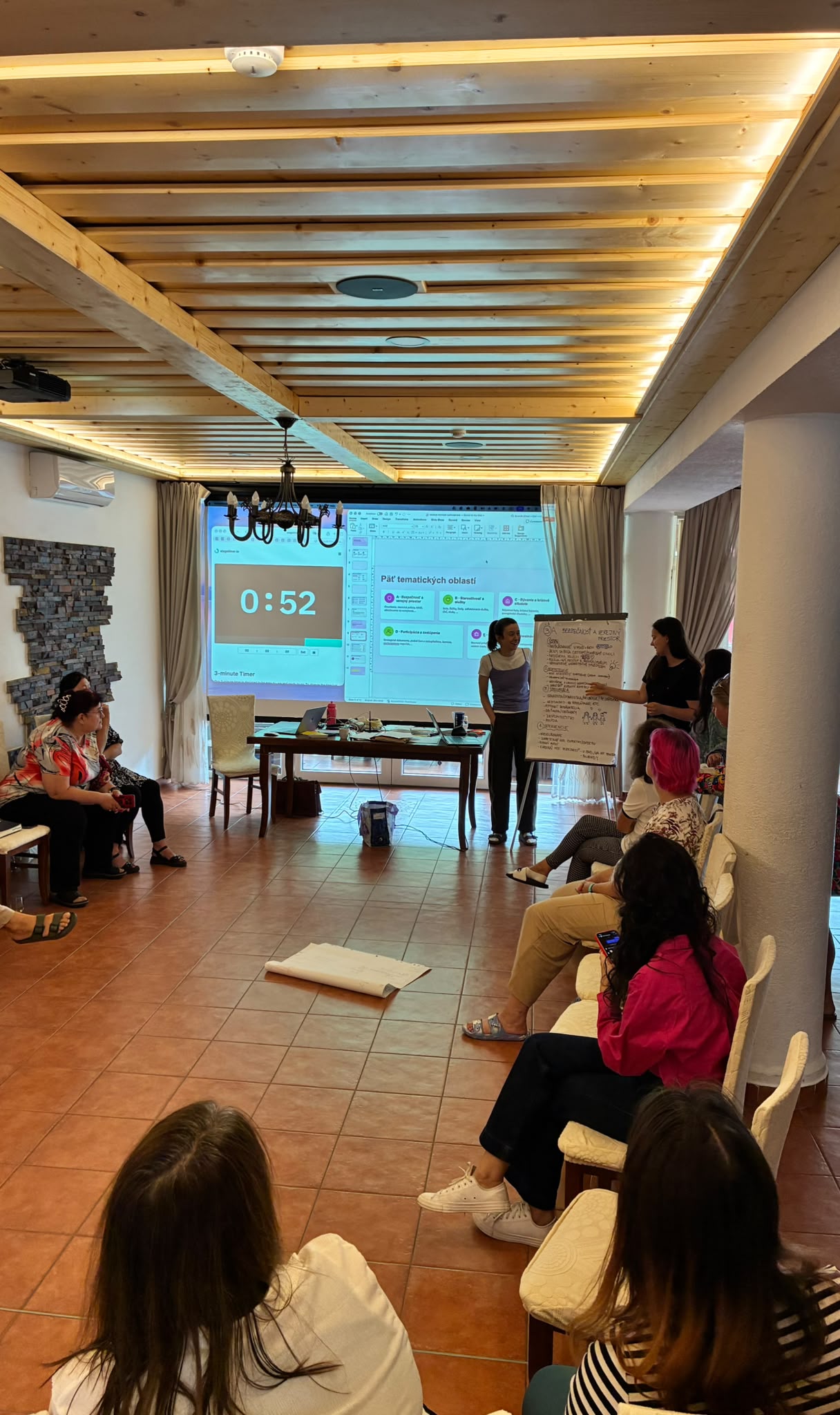
In August, we organized another Alumni Training session. The program covered several key topics: tracing the waves of feminism from historical roots to modern movements, advocacy strategies for medical abortion, and techniques for recognizing and addressing sexual harassment. Given the upcoming municipal elections, we also dedicated space to discussing gender equality in local politics.
Additionally, our team served as faculty members for the Human Rights Coalition’s Summer School in August. The five-day training introduced participants to core human rights frameworks, ranging from democracy and equality to civic engagement and social justice.


🌍 The Bulletin looks beyond Slovakia
Among other things, you can read about the opening of the first medication abortion center outside Skopje in North Macedonia, efforts to strengthen medication abortion education and telemedicine in Kyrgyzstan, and the latest developments in Albania, Armenia, Georgia, Hungary, Latvia, Romania, and Tajikistan.
Páči sa vám naša práca?
PODPORTE NÁSKategórie
Témy